
B2B marketing and sales materials Every material plays its part.
The buying journey has three stages: awareness, consideration, conversion. At each stage, your prospect is more or less “warm”: they do not know you, they are comparing, or they are ready to decide. Each material serves an objective at a specific stage. Click on a material to discover its role.
Awareness
Cold prospect
They do not know you yet. The objective: make yourself known.
Consideration
Warm prospect
They are interested and comparing solutions. The objective: start the conversation.
Conversion
Hot prospect
They are ready to decide. The objective: sell.
Blog articles
Its role
Make your brand, a product, a service, a piece of news or an event known.
Keys to success
Content designed for a precise objective and a clearly identified target (persona). Always look for what lies behind a search intent. On your own media, you keep full control and consistency of the message; the limit is the time and resources needed to produce quality content.
What we measure at this stage
Recognition of the message and its attribution to your brand. These actions lead to few or no direct sales, and that is normal: each stage has its own indicators.
Press release
Its role
A document sent to journalists to inform them of your company’s news. It puts your credibility on the line.
Keys to success
A short, clear and concise text, impactful in a few lines and written like an article. Picked up by the media, it generates coverage that increases your company’s visibility.
What we measure at this stage
Recognition of the message and its attribution to your brand. These actions lead to few or no direct sales, and that is normal: each stage has its own indicators.
Press kit
Its role
All the information and visuals relating to a brand or a piece of news, intended for journalists, bloggers and influencers.
Keys to success
More complete than a press release: several pages, with a larger number of visuals. Its goal: to get published in return.
What we measure at this stage
Recognition of the message and its attribution to your brand. These actions lead to few or no direct sales, and that is normal: each stage has its own indicators.
White paper
Its role
Expert content, longer and more in-depth than an article, that answers a specific question from your target. Offered as a download on a dedicated page, it lets you collect a contact: the prospect is no longer anonymous.
Keys to success
A topic that really matters to your target, a download landing page, and a planned follow-up: what happens after the download? A white paper takes time (writing, research, proofreading, layout): its cost should be calculated before getting started.
What we measure at this stage
Contacts who know you and start a conversation: meeting requests, newsletter sign-ups, social media followers, website visits.
Brochure
Its role
Present your company and your offer as a whole, in a few pages. It is handed over at a meeting or a trade show, or sent after a first conversation: the prospect keeps a clear record of what you do.
Keys to success
An overview, not the detail of each product: that is the role of the product sheet. Talk about benefits, keep the same message as on your website and your other materials, and use visuals that are easy to understand.
What we measure at this stage
Contacts who know you and start a conversation: meeting requests, newsletter sign-ups, social media followers, website visits.
LinkedIn posts
Its role
The leading professional network, covering every business sector. It lets you find your target and work on specific messages.
Keys to success
Social selling means using social networks to get closer to prospects and customers. The same content can be adapted into several formats: article, carousel, video, newsletter.
What we measure at this stage
Contacts who know you and start a conversation: meeting requests, newsletter sign-ups, social media followers, website visits.
Newsletter and emailing
Its role
Remind your contacts that you exist: product launches, announcements, promotions, newsletter.
Keys to success
A clear objective, a good-quality database, interesting and pleasant content, a precise call to action.
What we measure at this stage
Contacts who know you and start a conversation: meeting requests, newsletter sign-ups, social media followers, website visits.
Follow-up after a trade show
Its role
A contact who visited your stand has shown interest: they are looking for new products and information.
Keys to success
Friendly and interesting follow-ups that do not put too much pressure. And knowing when to let go, so as not to damage your brand image.
What we measure at this stage
Contacts who know you and start a conversation: meeting requests, newsletter sign-ups, social media followers, website visits.
Landing page
Its role
“The web page a visitor lands on directly after clicking a link.”
Keys to success
Position your product or service as a solution to your customers’ problem, and work on the page to maximise conversion. For the copy: the AIDA method.
What we measure at this stage
Prospects ready to become customers: quote requests, purchases, event attendance. The timeframe depends on your sector and decision time.
Product sheet or datasheet
Its role
A single product or service, in detail: features, benefits, proof. Where the brochure gives an overview, the product sheet goes into detail. The copy is decisive in the final phase of conversion: it must answer every question.
Keys to success
A simple, highly structured layout, several reading levels, clear reassurance, an obvious CTA. Pictograms, understood faster than text. And customer feedback to keep improving it.
What we measure at this stage
Prospects ready to become customers: quote requests, purchases, event attendance. The timeframe depends on your sector and decision time.
Sales pitch and sales presentation
Its role
Present an offer and anticipate objections by setting out its features, advantages and proof.
Keys to success
A sales pitch is a list of lines of reasoning that legitimise and defend your ideas. Every objection must be identified and addressed: digital has not replaced sales skills.
What we measure at this stage
Prospects ready to become customers: quote requests, purchases, event attendance. The timeframe depends on your sector and decision time.
Customer cases and testimonials
Its role
Customer feedback is a powerful form of social proof that influences buying decisions.
Keys to success
“Your best salesperson is your customer.” More authentic, personal and impactful content.
What we measure at this stage
Prospects ready to become customers: quote requests, purchases, event attendance. The timeframe depends on your sector and decision time.
In B2B
One sales cycle, several decision-makers.
In B2B, decisions take time and involve several people. Materials must support every stage of the sales cycle, not just the last one.
- 1
One action per stage
Each stage of the sales cycle has its marketing actions, with precise objectives and indicators.
- 2
Several stakeholders
The person who chooses, the person who pays and the person who uses are not always the same. Each one expects different answers.
- 3
Hot prospects go to sales
Lead scoring rates prospects according to their progress in the buying cycle, so that your sales team can focus on the hottest ones.
Our 5 rules
Talk about benefits
A consistent message across all materials
The right content, for the right target, in the right place, at the right time
Visuals that are easy to understand
Nothing generic
How we work
Nothing is generic.
Every material is built for your offer, your target and your objective, with copywriting that sounds like you.
Every project is unique
The message adapts to the characteristics and expectations of the audience: offer segmentation, needs analysis, personalised messages.
A promise to back up
Copywriting turns your positioning into a promise, carried by a benefit and a proof. What makes you unique should be identifiable in a few words.
Do not blend into the crowd
Aim to surprise, without overdoing it, to stand out from the competition.
Visuals that are easy to understand.
We favour diagrams over long paragraphs.
Compare: here is the same information, presented in two ways.
We start by understanding your company, your market, your products and your customers. We then define the objectives, targets, value proposition and messages, before creating the selected materials, content and web pages. We measure the results using indicators defined upfront, then adjust the actions based on what we observe.
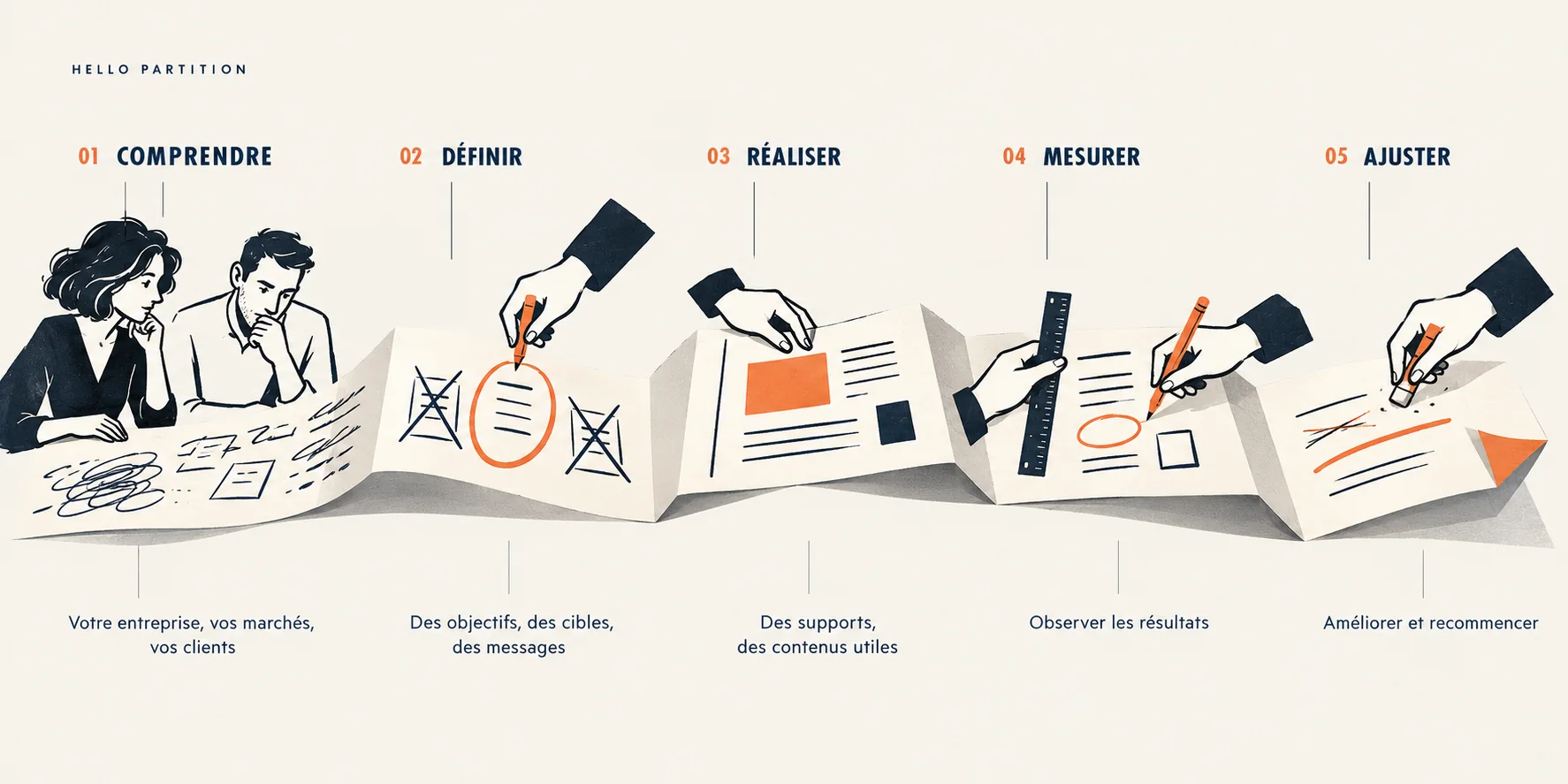
“If a picture is worth a thousand words, it replaces none of them.” The diagram supports the text, it does not remove it.
The more technical the product, the more a diagram is needed.
A technical product is explained with notions your customer does not always master: components, steps, roles. Faced with text alone, they have to picture for themselves how everything fits together. A diagram does that work for them: it shows what changes, in what order, and who does what.
“The brain takes time to analyse, because it tries to ‘picture’ the elements.”
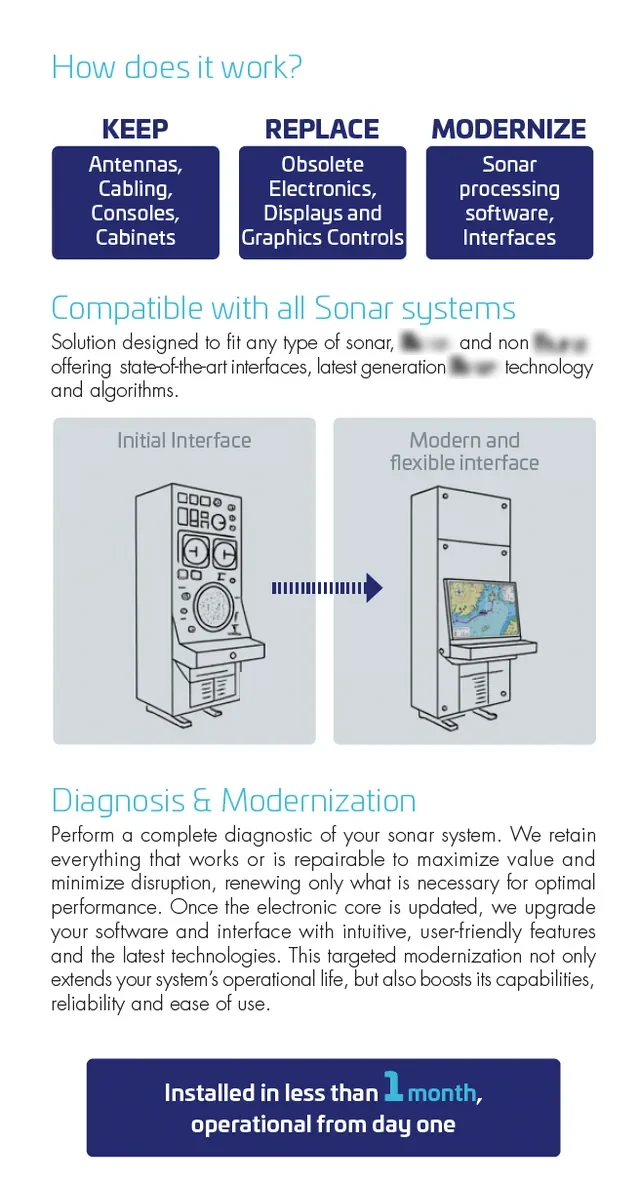
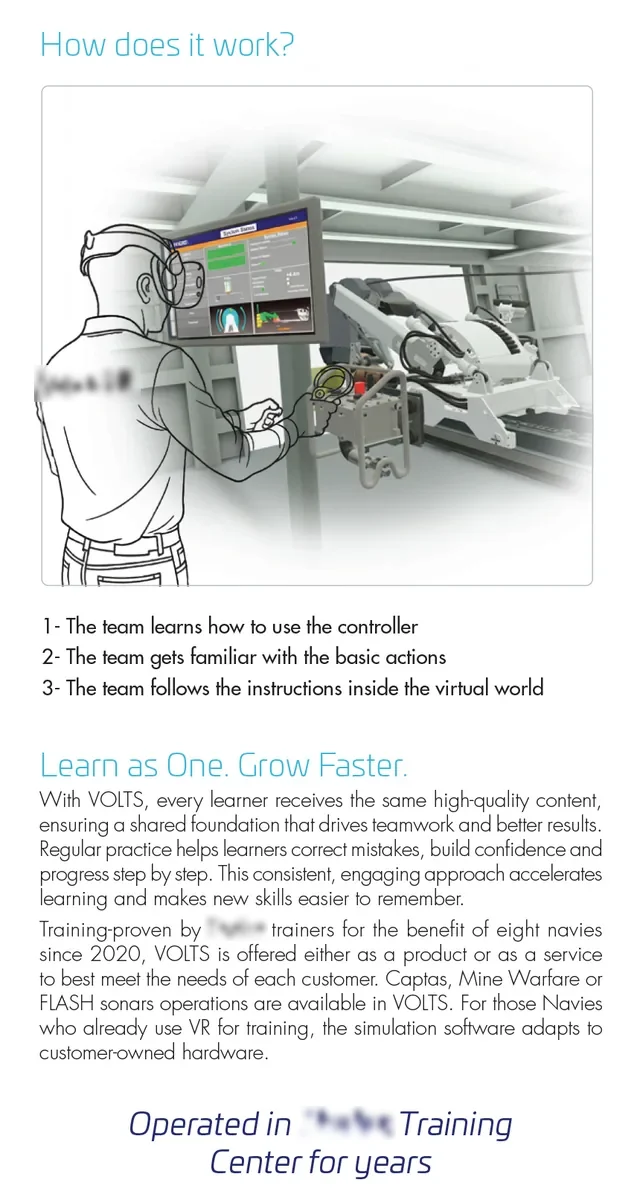
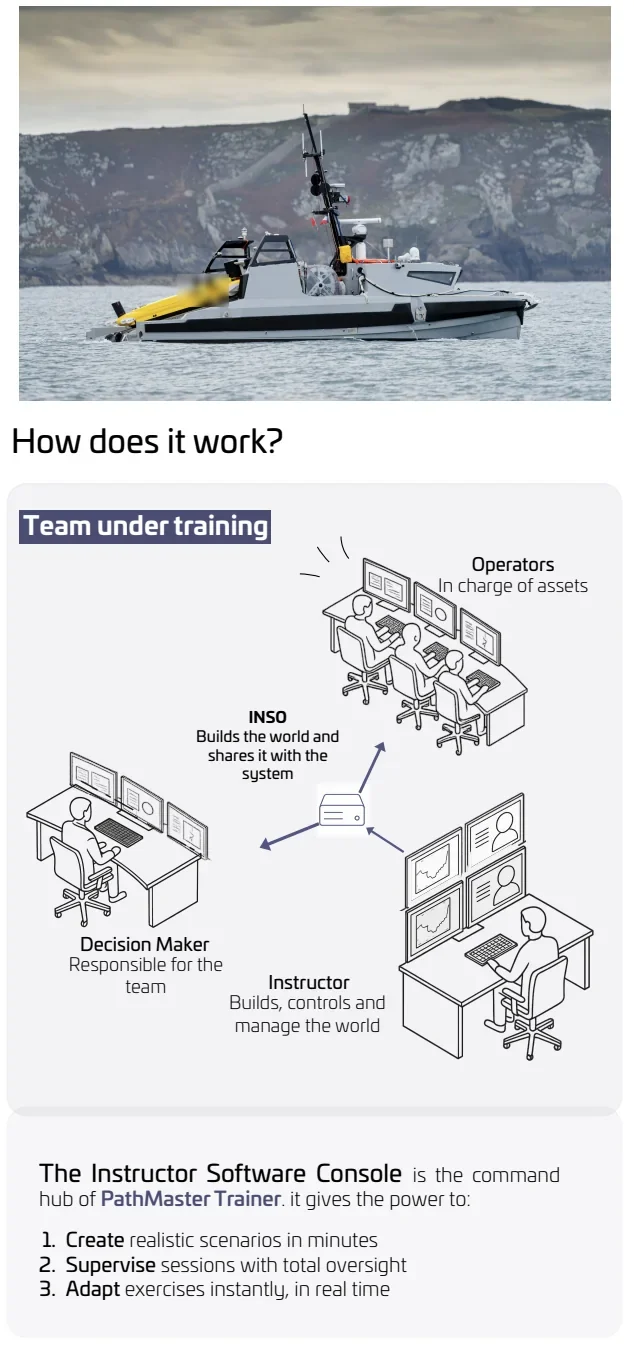
Diagrams created in-house for technical product sheets, during a previous professional position. The information shown is not confidential.
And after distribution?
A useful material can be measured. Provided you plan for it before distributing it.
- Plan tracking methods upfront: dedicated links, QR codes, forms.
- Each stage has its own indicators: you do not measure an article like a landing page.
- A QR code scan shows interest, not a sale.
- Observe the results, then adjust the material.